
The Sensex jumped 412.23 points on Friday, braving heavy volatility during the day, amid the Reserve Bank of India maintaining status quo on the benchmark lending rate and buying in index heavyweights Reliance Industries Limited and ITC. The BSE Sensex climbed 412.23 points or 0.70 per cent to settle at 59,447.18. During the day, the benchmark hit a high of 59,654.44 and a low 58,876.36. The Nifty also gained 144.80 points or 0.82 per cent to finish at 17,784.35.


Having grown swiftly since the acquisition of Flipkart by Walmart in 2018, it was looking at a valuation of $10 billion. However, factors such as lack of diversification, new e-commerce and data policies, as well as the overall investment environment, have slowed the process.

China's economy is in transition, with rising wage costs and massive overcapacity.

India's consumer digital economy which was pegged at $85-90 billion in calendar year 2020, is expected to become a $800 billion market by 2030, according to reports released by consulting firm RedSeer at its flagship event Ground Zero 5.0. The digital economy includes 60 per cent of travel, 40 per cent non-grocery retail, 30 per cent of education, 25 per cent of food and beverages services and 6 per cent of pharma/grocery going through digital channels by calendar year 2030. Online retail is set to become the third-largest market by scale by CY30 with an annual gross merchandise value (GMV) of $350 billion in CY30, said RedSeer.

'For equities, inflation trending upwards but within the range of expectations can actually be a big positive as it helps earnings and may shift flows from bonds to equities.'
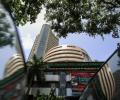
Market sentiment suffered a jolt after other Asian markets closed with widespread losses and European markets dropped in early trade

To help revive the economy battered by COVID-19, Finance Minister Nirmala Sitharaman on Monday announced a slew of measures, including Rs 1.1 lakh crore credit guarantee scheme for improving health infrastructure, and enhancing the limit under the ECLGS by 50 per cent to Rs 4.5 lakh crore for the MSME sector facing liquidity crunch. Sharing the details of stimulus package, the finance minister said this comprises eight relief measures and other eight measures to support the economic growth. She announced Rs 1.1 lakh crore loan guarantee scheme for COVID-affected sectors, including health sector, which includes guarantee cover for expansion or for new projects. Besides, she said, additional Rs 1.5 lakh crore limit enhancement done for Emergency Credit Line Guarantee Scheme (ECLGS) scheme.

Despite the headwinds both on the domestic and global fronts, Ramesh S Damani, member, BSE and a prominent investor, says India will weather a global trade war better than a lot of other Asian countries.

'One can start accumulating economy driven stocks in the next few months with a two-three year view.'

In the manufacturing sector, output is expected to decline by about 70 per cent as only food-processing, and drugs and pharma industries are allowed to operate while other segments, such as engineering and metals, have shut operations.

Sales expansion also down 4.4%

Import growth moderated to a four-month low, owing to sharp decline in that of gold.

Large investors track high-frequency data that is immediately available today. That data has been bullish, points out Debashis Basu.

'One of the biggest issues the Indian economy faces right now is of job creation...' 'The nexus between growth and employment has to be closed...' 'In the absence of a manufacturing expansion, the alternative is to have the service sector as the driver of both GDP as well as employment growth.'

Growth in the eight core sectors jumped to 8.5% in April, due to a sharp pick-up in refinery products and a commensurate rise in electricity generation.

FPIs sold shares worth a net Rs 1236.95 crore on Friday.

The total value of India's top 100 brands has increased by 2 per cent, from $162.1 billion in 2020 to $164.9 billion in 2021, according to the latest Brand Finance India 100 2021 report. This uplift in brand value over the course of the first year of the pandemic is an impressive feat given the global economic crisis following the implementation of national lockdowns in March 2020, when business activity was brought to a halt, affecting both production and consumption. Among the brands that came on the top of the list include Tata Group, Reliance Industries, and Mahindra Group.

The hit to economic activity will be mostly confined to the first quarter. And a third wave, if it materialises, is unlikely to be hugely disruptive for the economy, predicts T T Ram Mohan.

Vehicle sales across categories registered a decline of 8.62 per cent to 20,86,358 units from 22,83,262 units in May 2018.

Moody's Investors Service on Friday said India's economy is expected to contract for the first time in more than four decades saying economic damage owing to the coronavirus-induced lockdown will be significant with lower consumption and sluggish business activity. Even before the coronavirus outbreak, Indian economy already was growing at its slowest pace in six years and with the stimulus measures announced by the government falling short of expectations, the disruptions are likely to be greater. "We now expect India's growth to register a real GDP contraction for the fiscal year ending in March 2021 (fiscal 2020-21), from our earlier projection of zero growth," it said in a research note.

In a bid to support revival of sectors hit most by the Covid-19 pandemic, Reserve Bank of India on Friday decided to open a separate liquidity window of Rs 15,000 crore for certain contact-intensive sectors like hotels and restaurants, tourism and aviation ancillary services.
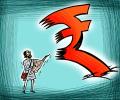
Indian rupee, which earlier this week touched an all-time low, is likely to remain under pressure and may test new levels as a fallout of the US Federal Reserve indicating more interest rate hikes, experts said. The aggressive rate hikes will dampen demand and increase the possibility of a recession in the US. This could accelerate the pace of capital outflows, weaken the rupee and raise the threat of imported inflation.
With global markets pushing ahead, enthused by strengthening US jobs market, and also due to prospects of European rate hike, Indian markets also continued the march ahead.

The economy hasn't gathered even half the traction that some of us assumed it would just a year back.

Yes Bank was the top gainer in the Sensex pack, rallying 6.74 per cent, followed by TCS, Tata Motors, Bharti Airtel, M&M and RIL.
''We have a very difficult period ahead of us.' 'Fortunately we have a popular government and a popular leader who is ideally placed to take us into confidence,' says Aakar Patel.
The economy has shown sharp resilience in the past and has also bounced back in good time. We could hence expect a similar trajectory next year, observes Madan Sabnavis, chief economist, CARE Ratings.

A weak US dollar in overseas markets was the main reason for the rupee's rise even as losses in domestic stocks and some fag-end dollar demand from importers prevented further gains

Mumbai's alternative business district of Bandra-Kurla Complex was at 18th position.

A strong showing will be vital to Narendra Modi's chances of a second term.


'Aquaponics can effectively cushion the impact of a calamity like COVID.'

Nikunj Saraf, Vice President Choice Wealth, answers your queries.
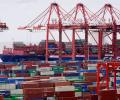
After staging a strong recovery from COVID-induced slowdown in 2021, India's exports are likely to extend the growth story to the New Year also on increased demand in the global markets, boost in domestic manufacturing due to production-linked incentive schemes and implementation of some interim trade pacts. Expectations of positive growth in the country's exports are also backed up by the outlook of the World Trade Organisation (WTO) which predicts a 4.7 per cent expansion in the global merchandise trade volume in 2022. Exporters believe that the outbound shipments would cross $400 billion mark in this fiscal going by the current momentum and may reach $475 billion in 2022-23.

For non-banks, the IL&FS crisis was nothing short of India's Lehman moment, which has for a foreseeable future reset the sector on multiple grounds.

Walmart-owned digital payments firm PhonePe has decided to halt its proposed acquisition of Goldman Sachs- and Xiaomi-backed ZestMoney, a Bengaluru-based buy now, pay later (BNPL) platform. The deal, which was poised to fetch anywhere between $150-200 million and $300 million, has hit a snag over lapses in due diligence, disagreements over valuation, sustainability of the business, and shareholding structure of ZestMoney, according to people familiar with the matter. The collapse of the deal is also being attributed to a slowdown in the financial technology (fintech) sector in the midst of a funding winter, difficult regulatory environment, and macroeconomic uncertainty, informed other sources.

After a stellar run in 2021 that saw the S&P BSE Sensex and the Nifty50 clock gains of 20 per cent and 22 per cent respectively, global equity markets, including India, are gearing up to welcome 2022 on a cautious note. For one, new variants of the Covid -19 infection that make current vaccines less effective is one of the key risks worth flagging, analysts said. Inflation was also a risk for this asset class in 2021, although most market participants expect that the current elevated inflation levels will be transitory.

'Unemployment barely figures in the Budget except as a derived demand from the industry and infrastructure.' 'There is no effort at direct attack on unemployment.'

Slowdown persists in China. India's GDP estimates for 2015-16 are liable to be pared; projections for 2016-17 are lacklustre.
